
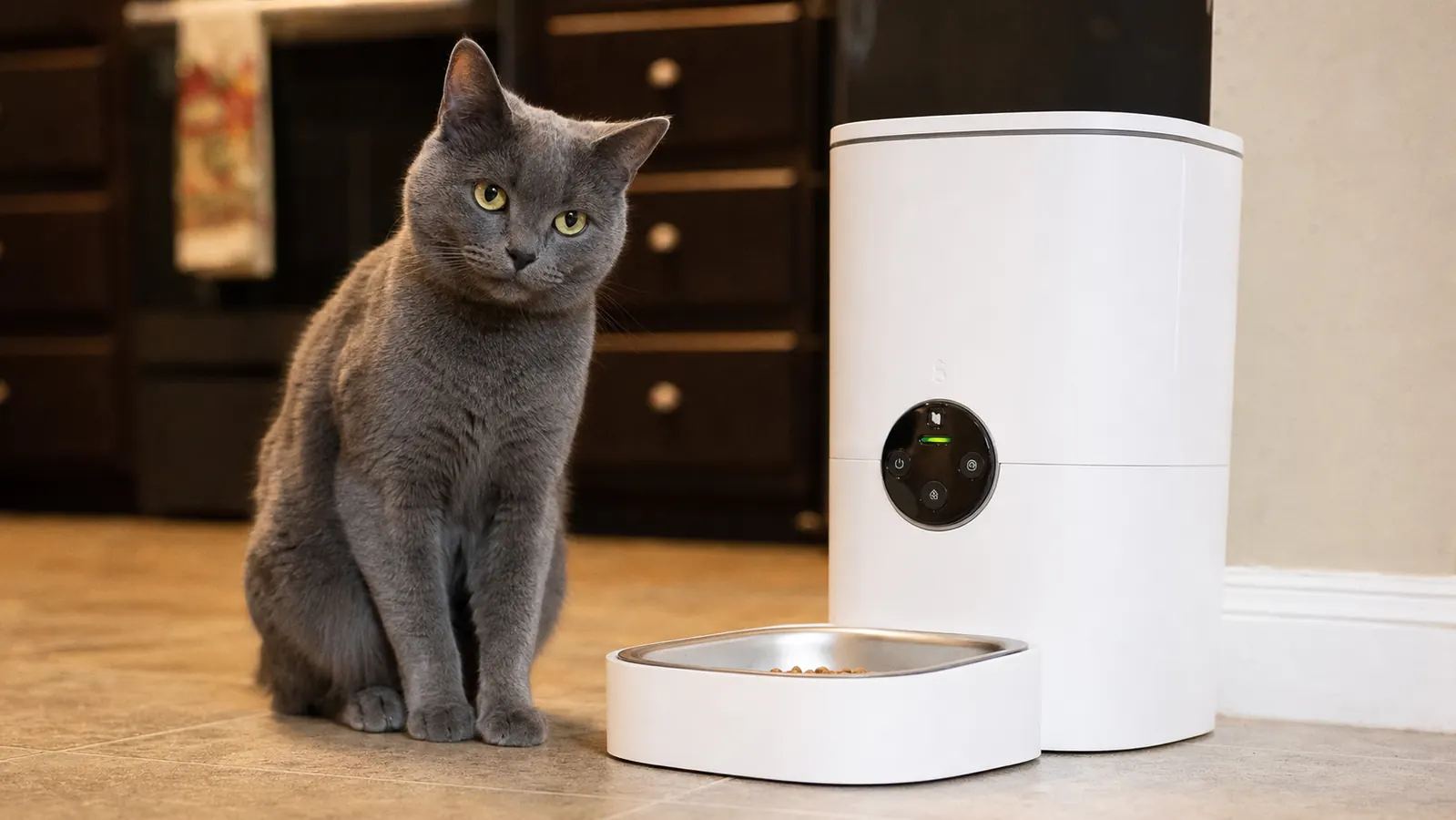
Let me tell you the version of this review I wish I had found before I ordered the VOLUAS Automatic Pet Feeder. Not the listing. Not the star-average. The version where someone who actually set it up, ran into the weird edge cases, and figured out what this feeder is and is not good for just tells you the truth. I bought mine for my two cats, Rue and Pepper, and my sister's corgi Dumplin who stays with me most weekends. I am not a lifelong automatic-feeder believer. I tried a cheaper unit two years ago that jammed twice in the first week and went straight back. So when I say the VOLUAS (ASIN B09LD2CD1L) eventually won me over, it is not because I was rooting for it.
The short answer: it works. The longer answer involves four things nobody puts in the listing that will matter a lot depending on your situation. I will cover all of them, and I will also tell you exactly who should skip this feeder entirely, because for some pet owners it is the wrong tool even though it is a good product.
The Quick Verdict
Reliable dispenser with genuinely good portion control for small round kibble, but the setup is fussier than the listing implies, the lid is the weakest part of the whole unit, and if your pet eats anything other than standard dry kibble this feeder is not built for your situation.
Amazon Check Today's Price →If your pets are waking you up before your alarm or going without food while you work long days, this feeder is the practical fix.
The VOLUAS has 4.4 stars across more than 12,000 Amazon reviews. Check today's price and current availability before you decide.
Amazon Check Today's Price on Amazon →What Nobody Tells You Before You Buy This Feeder
I want to lead with the gotchas because that is what this review is for. The positive stuff is all over the listing.
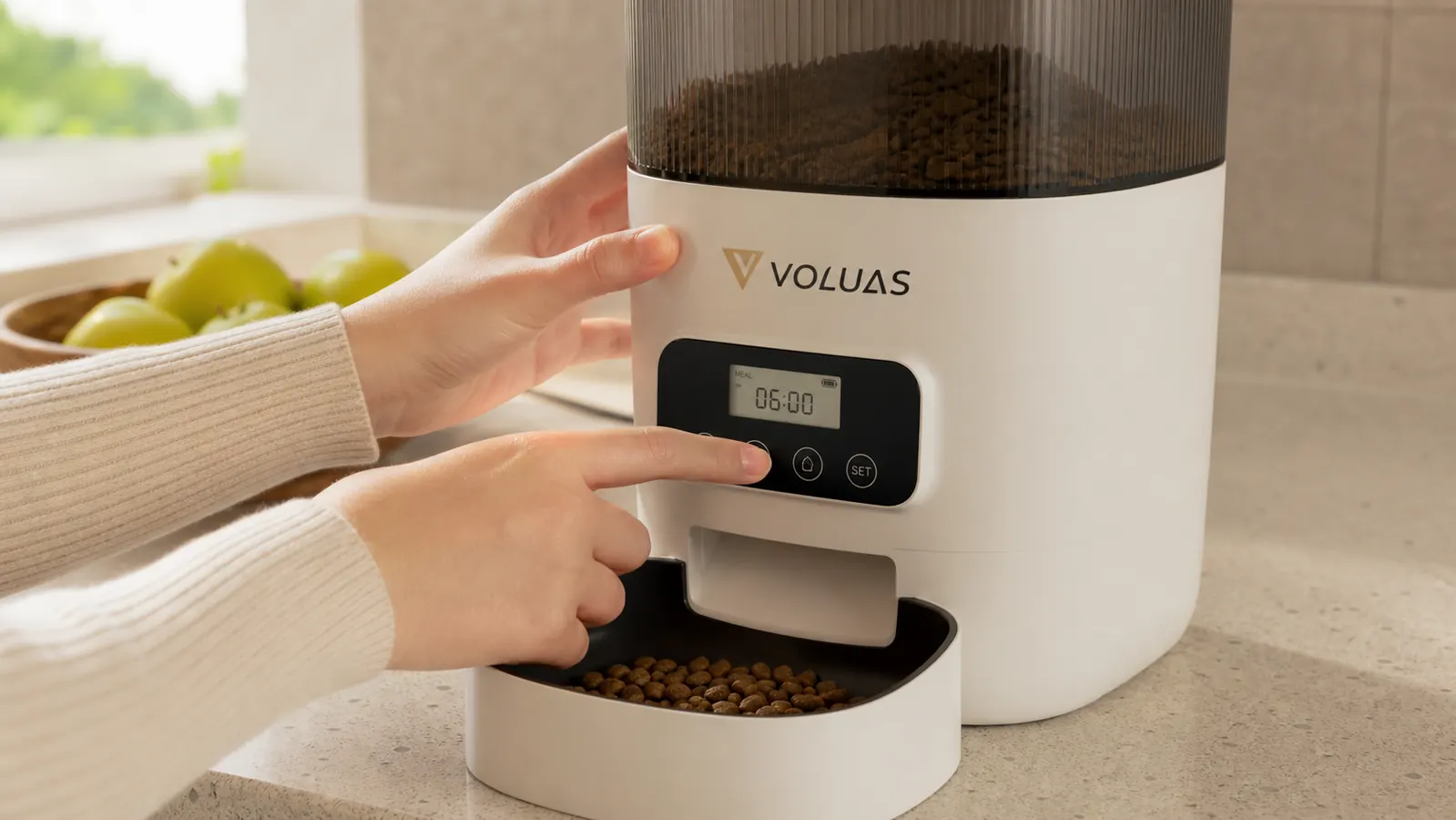
Gotcha one: the clock setup is genuinely annoying the first time. The VOLUAS has no app. You program the internal clock and each meal slot using a small four-button panel on the top of the unit. The buttons are unlabeled except for two symbols that are not immediately obvious, and the manual is a translated document that uses phrases like 'press setting key to confirm eating quantity' without explaining which key is the setting key. It took me about thirty minutes to get the clock set correctly and three meals programmed, and I had to restart the process once after I accidentally locked myself out of the menu. This is not a dealbreaker, but if you are not comfortable with small button-based programming, budget an hour and watch a YouTube setup video before you start. The process is not intuitive.
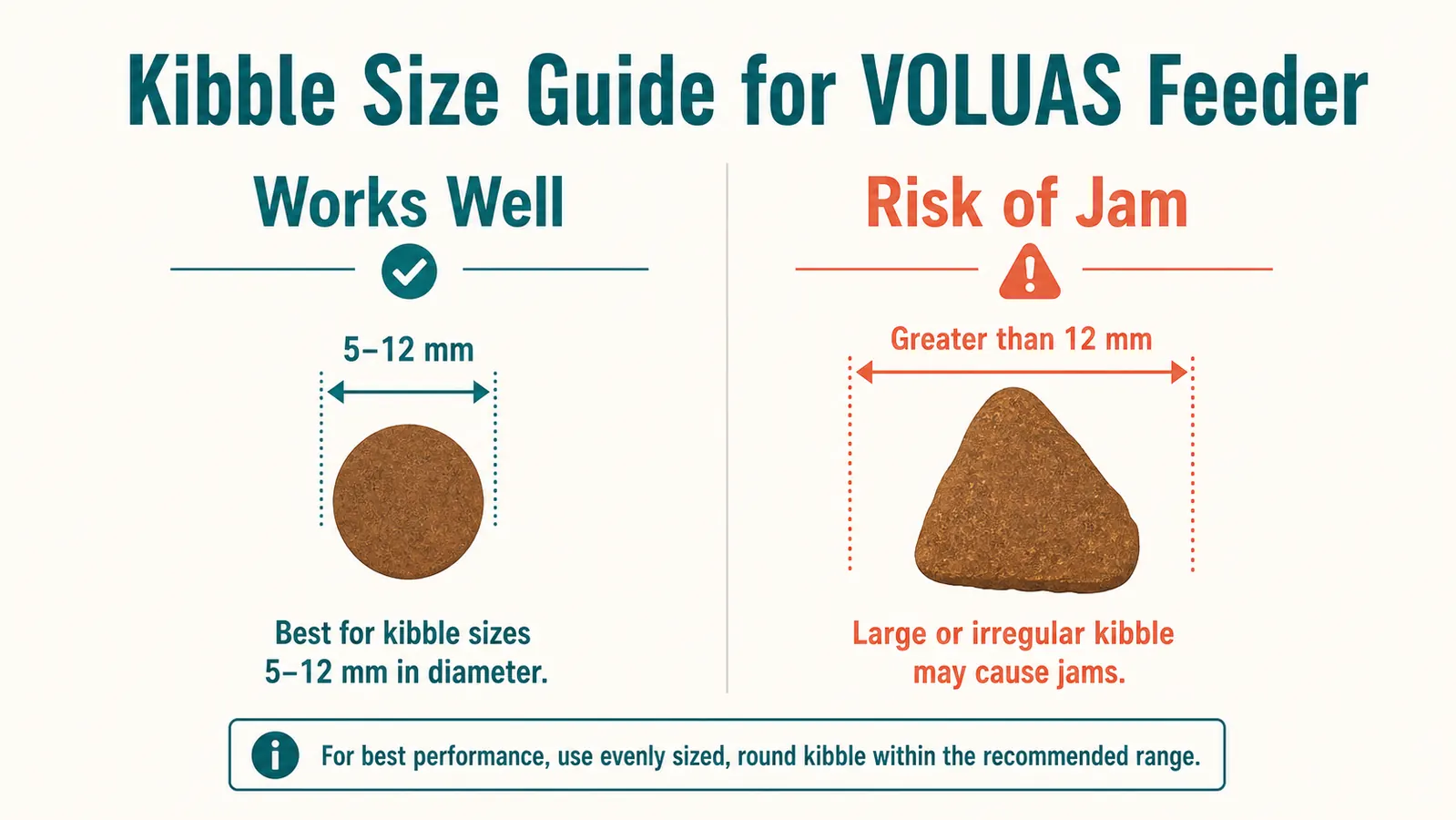
Gotcha two: kibble size is everything, and the listing does not say this clearly enough. The VOLUAS uses a rotating disc with pockets to measure and release food. The pockets are sized for standard dry kibble, roughly 8-10mm in diameter, small round pieces. If your pet eats a larger kibble, irregular shapes, or anything triangular or star-shaped, you are gambling on whether it will dispense cleanly or bridge across two pocket openings and jam. When Dumplin was visiting, I tried running her regular food, a larger diamond-shaped piece from a different brand, through the feeder. It jammed on the third dispense. Not a catastrophic jam, the feeder beeped an error code and I cleared it in under a minute, but it happened, and it happened again two days later. I switched her back to hand feeding for the visits after that.
Gotcha three: the lid is the weak link. The hopper lid has a plastic tab closure, not a locking twist or a latch with any real tension. Rue, one of my cats, spent the first week sizing it up. She has not managed to open it, but she has figured out that it moves when she paws at it, and I now keep the feeder on the counter rather than the floor specifically to prevent a determined midnight raid. If you have a cat who has ever opened a cabinet, a drawer, a tupperware lid, or a bag of treats on her own, this lid is not going to stop her. I have seen enough Amazon reviews where people reported exactly this scenario to take it seriously. VOLUAS does sell replacement lids and there is a third-party lock kit that fits, but you should not have to buy accessories to solve this on a new feeder.
Gotcha four: the 4-liter capacity is bigger than it sounds but smaller than some owners expect. Four liters holds roughly 17 cups of dry kibble. For two cats eating a combined 80-100 grams per day, that is about 10-12 days per fill. For a medium or large dog eating 200-plus grams per day, you are refilling every four or five days. That is not a complaint, it is just a reality check if you were imagining a fill-it-and-forget-it situation for a big dog.
How I've Been Using It (and What Actually Works)
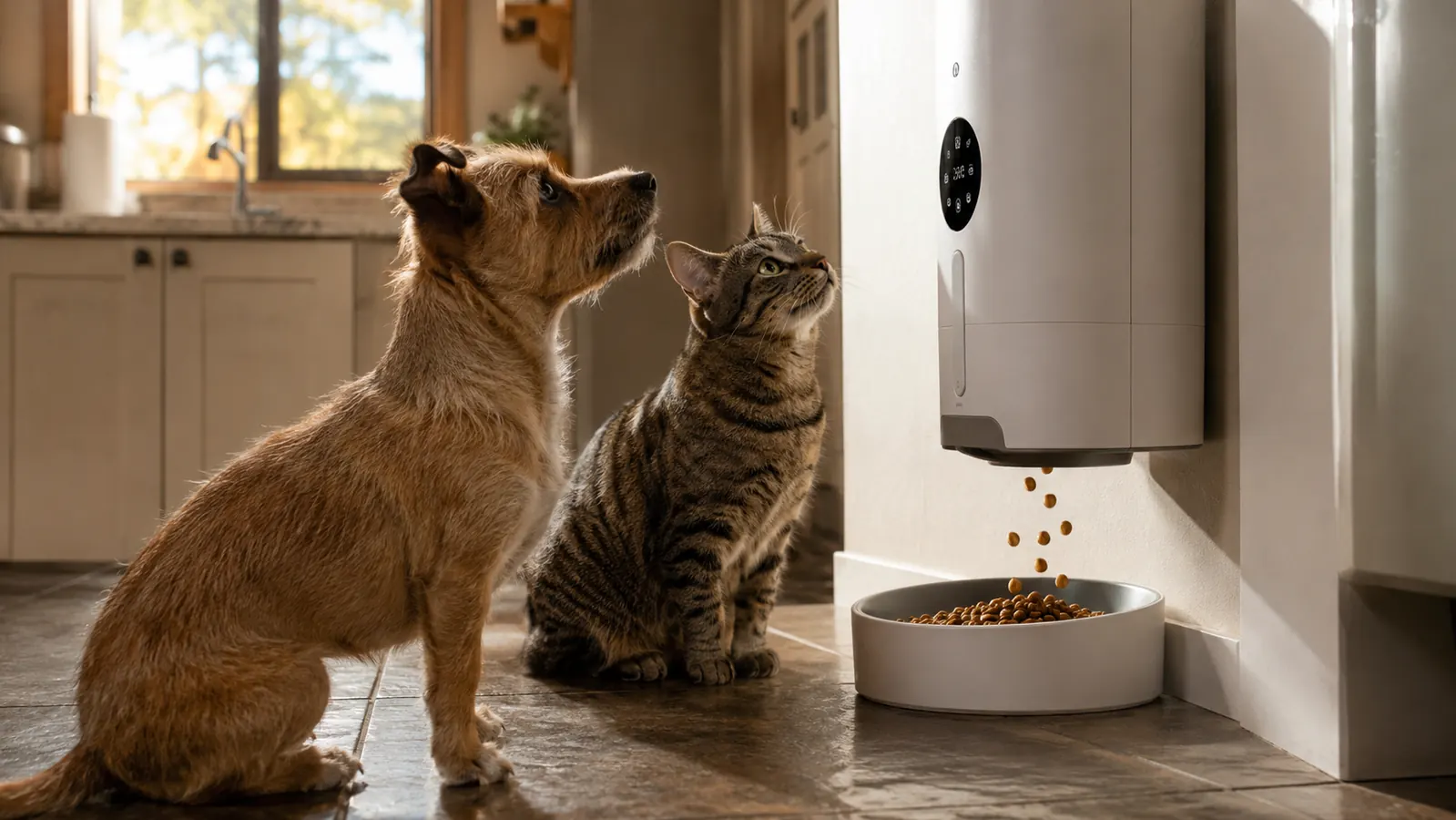
Once I got past the setup friction, the VOLUAS settled into a routine I have not had to think about in weeks. Rue and Pepper get three meals a day: 6:30 a.m., 12:30 p.m., and 5:30 p.m. Each meal is two portions, which works out to about 10-12 grams of their kibble, a small round Royal Canin piece. Both cats learned the schedule within three days. By day four they were camped near the feeder about five minutes before each scheduled meal, which is the behavioral signal that tells you the feeder is working.
The voice recorder feature is one I was prepared to dismiss. You hold a button and record ten seconds of yourself calling your pet, then the feeder plays it back at every meal. The playback quality is grainy, noticeably worse than a smartphone speaker at low volume. But it works as a conditioned cue. Both cats come running at the sound, even when I am in another room, in a way they do not respond to just the sound of the motor. If you have a skittish pet who might startle at the clicking motor noise, recording a familiar voice first and pairing the call with the meal sound from the start is genuinely a useful way to introduce the feeder. I just want to set accurate expectations: you will not mistake it for high fidelity.
Portion Control: What It Gets Right and Where It Slips
I weighed my cats' meals for the first ten days after setup because Pepper had been putting on weight and I wanted to know whether I was actually delivering a consistent amount. At two portions per meal, the feeder dispensed between 9.8 and 12.1 grams of Royal Canin per shot. That is about a 20% swing at the extremes, but the median landed within about 5% of my target, and over the course of a week the total delivery was close enough to planned intake that Pepper's weight has held steady for three months. For cats on a general maintenance diet, the accuracy is fine. For a pet on a precise veterinary weight-loss plan where every gram matters, I would weigh a full week of shots before relying on the feeder as your only tool.
The portion settings go from 1 to 39, with each unit equaling roughly 5-6 grams of standard kibble. You set a number per meal, not a gram amount, so there is math involved up front. If your vet gives you a daily calorie target, you will need to know your specific kibble's calories per cup, then work backward to figure out how many portions to program. That is probably two minutes of arithmetic, but it is not spelled out in the manual and some owners get frustrated when their portions do not match what the bag's feeding guidelines suggest.
Build Quality and Cleaning: Better Than I Expected
The exterior is white ABS plastic, the same material as most budget kitchen appliances. It is not going to win any awards for premium feel. It scratches if your cat shoves it across a tile floor, which mine have done. The bowl is plastic on the version I received, and I swapped it immediately for a small stainless bowl I had on hand because Pepper has mild chin acne and plastic bowls make it worse. The dispense chute drops kibble into whatever bowl sits below it, so swapping is just a matter of repositioning.
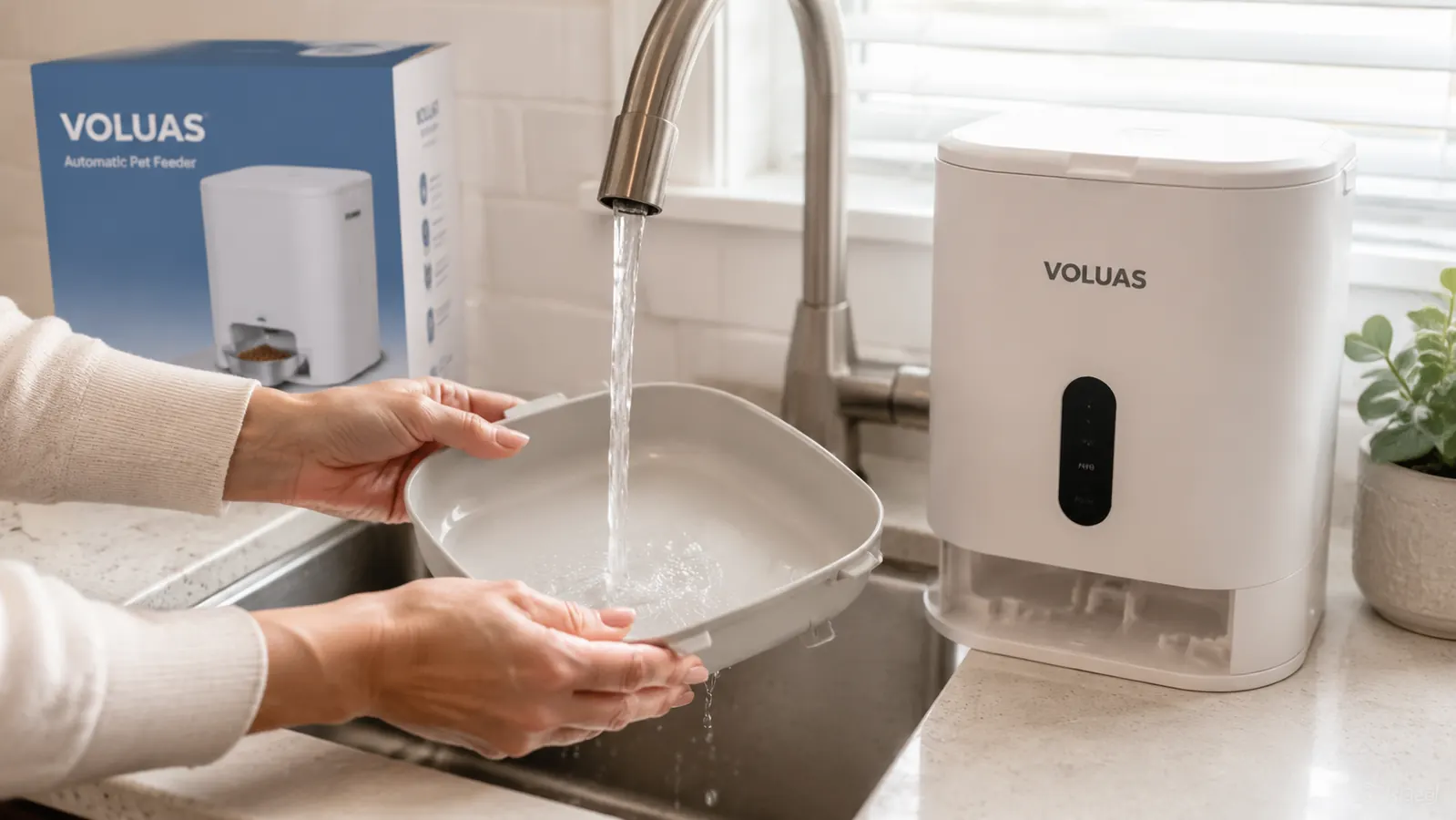
Cleaning is where this feeder does better than I anticipated. The rotor disc and food tray both pull out by hand, no tools, in under ninety seconds. Both go in the sink with warm soapy water. The hopper itself I wipe out with a damp cloth. After three months of weekly cleaning I have had no kibble residue buildup, no smell, and no visible wear on the plastic food-contact surfaces. The motor unit itself you keep dry, which is obvious, but the design makes it easy to separate the wet-washable parts from the electrical parts. That is genuinely thoughtful for a feeder at this price point.
The backup battery compartment takes three D-cell batteries and the unit will hold its programmed schedule for about a day on batteries alone. The power adapter is a standard two-prong plug and the cord is long enough to reach most outlets without an extension. If you are placing this feeder in a spot that is far from an outlet, measure first. The cord is not extra long.
Three months of three meals a day. Both cats know the schedule better than I do. That is the real value: not the gadget, but the routine it creates for your pet.
The No-Wi-Fi Reality: Who That Hurts and Who It Does Not
The VOLUAS has no app and no Wi-Fi. This is either a non-issue or a significant problem depending on how you plan to use it. If you want to check that a meal dispensed while you were at work, you cannot do that from your phone. If you want to push an extra meal remotely because you are running late, you cannot do that either. If you travel overnight and leave a pet sitter, the sitter cannot adjust the schedule without physically being at the unit. For many owners, none of this matters because the feeder is running a set schedule that does not change. For owners who want remote visibility and control, the PETLIBRO Granary or similar Wi-Fi feeders are in a different category. The comparison between the VOLUAS and the PETLIBRO is worth reading if you are on the fence: I cover the full side-by-side in the VOLUAS vs PETLIBRO article.
What I can tell you is that the no-app design does mean one less thing to break, one less account to create, and one less device on your home network. If you are not someone who particularly wants to monitor your pet's meals from a dashboard, the simplicity is actually a feature. My feeder has never had a firmware update fail or lost its schedule because of a Wi-Fi dropout. It just runs.
Setting It Up the Right Way: What I Would Do Differently
If I were doing this again, here is what I would change about my setup process. First, I would find a YouTube video of someone setting the clock before I took the feeder out of the box. The physical manual will get you there but watching someone navigate the buttons once makes it click immediately. Second, I would test three dispense cycles with my actual kibble before I programmed the full schedule. Put a bowl under the chute, set a manual dispense, and weigh what comes out. If it is not dispensing cleanly or you are getting a jam on irregular kibble, you want to know that before the feeder is running overnight. Third, I would decide on the feeder placement before I recorded the voice message, because where you put the feeder determines where your pet learns to go for meals, and that location should be stable.
One more thing worth knowing: the feeder beeps when a meal dispenses. Not loudly, but audibly from across the room. If you are a light sleeper and the feeder is running a 6 a.m. meal in an open floor plan near the bedroom, you are going to hear it. I moved mine to the kitchen corner and closed the hallway door, and that solved it. But if you live in a studio or a small apartment, the sound is part of the deal.
What I Liked
- Dispenses reliably once you learn the button programming, no missed meals in three months of daily use
- Portion control is good enough for standard small round kibble and general maintenance feeding
- Cleans in under ninety seconds, rotor and tray pull apart by hand with no tools
- Battery backup holds the schedule through a power outage, no reprogramming needed when power returns
- Cats learned the schedule within three days and now self-cue to the feeder without extra prompting
- Simple button interface means no app, no account, no network dependency, nothing to update or break remotely
- Reasonable price for a feeder that actually works across multiple pets and meal types
Where It Falls Short
- First-time setup is genuinely confusing, plan thirty to sixty minutes and find a tutorial video first
- Kibble size compatibility is strict, larger or irregular shapes jam the rotor and the listing downplays this
- Lid latch is not cat-proof for a determined, food-motivated pet and loosens over time
- No Wi-Fi or remote access, no way to verify a meal dispensed or push an extra meal from your phone
- Dispense beep is audible at 6 a.m., light sleepers in open floor plans will hear it
- Included bowl is plastic, worth swapping for stainless if your cat is prone to chin acne
Who This Is For
This feeder is a good fit for owners with one or two cats or a small to medium dog eating standard dry kibble with a piece size under about 10mm. It is a good fit if your main problem is consistency: your pet is hungry at the same times each day, and you are not always home or available to feed on schedule. It is also a good fit if you want simplicity over connectivity, a feeder that runs without an app, without a Wi-Fi password, and without a subscription. Pet sitters and family members who watch your pets love it because there is nothing to configure on their end, the food just comes out when it is supposed to.
It is also a solid option if you are transitioning a free-fed cat to structured meals, which is often a vet recommendation for weight management. The feeder handles the transition better than you do, because it does not cave to crying at 4 a.m. Your cat is going to be annoyed for about a week. The feeder does not care. If you want to understand the full picture of why scheduled feeding matters for pet health, the setup guide for automatic pet feeders covers portion math, timing strategy, and how to transition a free-fed pet without a lot of drama.
Who Should Skip It
Skip the VOLUAS if your pet eats wet food, raw food, or a combination of wet and dry. This feeder is a dry-kibble-only device and there is no version of it that safely handles anything moist. Skip it if your pet eats a large or irregular kibble, specifically anything bigger than a standard small or medium breed piece, and you are not willing to switch kibble brands to make it work. Skip it if you have a highly food-motivated cat who has broken into sealed containers before. The lid will eventually fail against a truly determined animal. Skip it if remote monitoring matters to you, for example if you travel for work and want to confirm each meal dispensed from your phone. And skip it if you hate button-based setup interfaces, because there is no getting around the programming process and it is not as smooth as the listing implies.
Fed up with alarm-clock feeding and wondering if your pet eats enough when you are not home? This is the feeder that fixed both problems for my cats.
Over 12,000 owners, 4.4 stars. If your pets eat standard dry kibble and you want a reliable, no-app feeding schedule, check today's price on Amazon.
Amazon Check Today's Price on Amazon →