
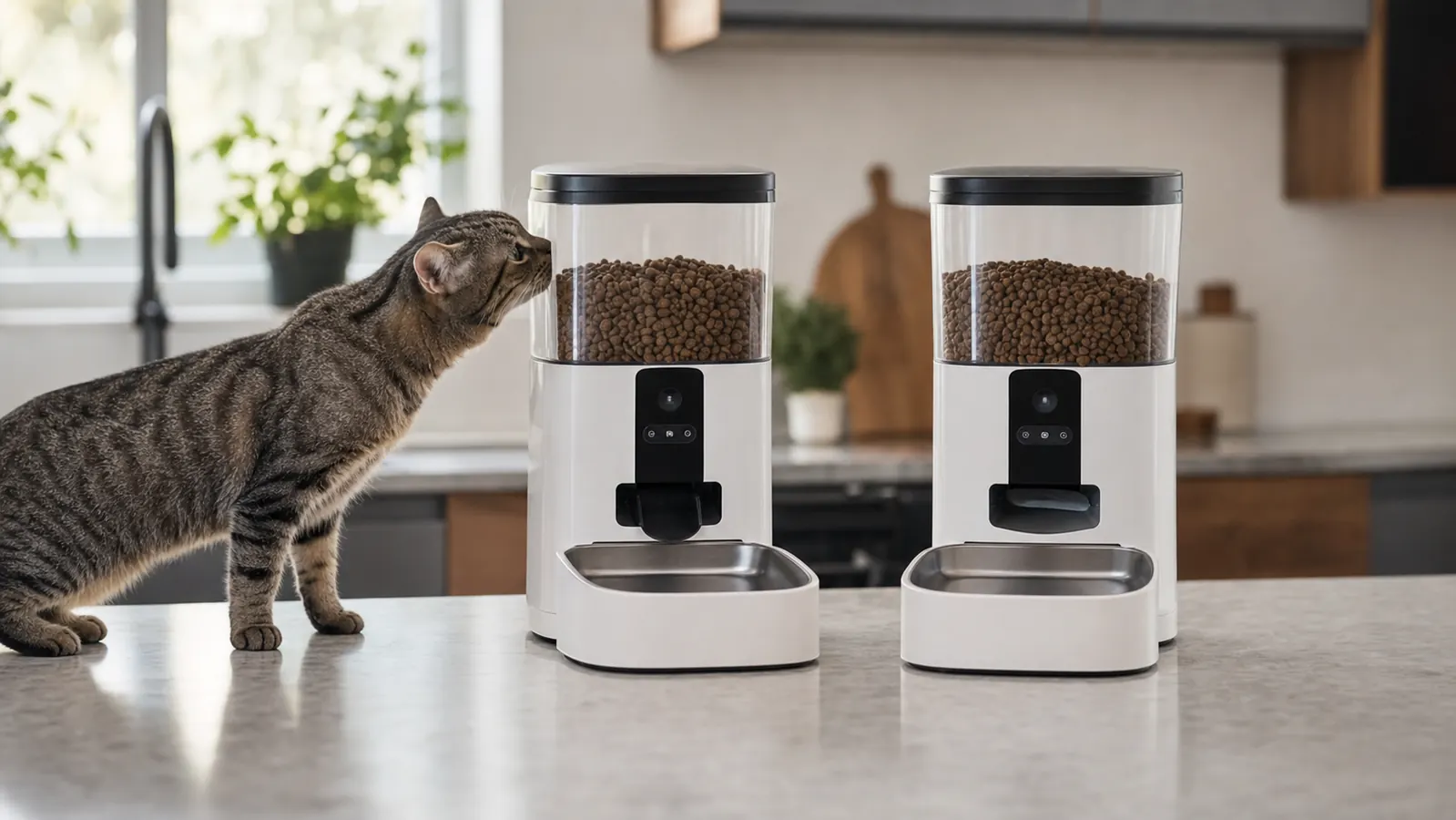
Here is the short answer: if you want an automatic pet feeder that works reliably without requiring a phone app, runs on both AC power and AA battery backup, and records your own voice to call your pet to the bowl, the VOLUAS is the better buy for most households. The PETLIBRO is a capable feeder and some versions are well-reviewed, but it leans harder on a Wi-Fi app connection that adds a failure point most buyers do not think about until it fails. For cat and dog owners who want set-it-and-forget-it scheduled feeding, the VOLUAS edges it out on practical reliability, hopper size, and total cost.
I have been using the VOLUAS for my two cats, Biscuit and Pickles, for several months. I looked seriously at the PETLIBRO before pulling the trigger, spent time reading through a few hundred reviews on both, and ultimately landed on VOLUAS for reasons I will get into below. This is not a sponsored take. I bought this feeder with my own money and I am not in the business of pretending every product I write about is perfect.
| VOLUAS | PETLIBRO | |
|---|---|---|
| Hopper Capacity | 4L (approx. 17 cups dry kibble) | Varies by model; most popular is 3L |
| Power Source | AC adapter + 3x AA battery backup | AC adapter only (most models); some have USB-C |
| App or Wi-Fi Required | No app required; programs entirely on-unit | Most models require the PETLIBRO app for scheduling |
| Voice Recorder | Yes, 10-second custom recording | Select models only; not standard across lineup |
| Max Meals Per Day | Up to 6 scheduled meals | Up to 6 scheduled meals |
| Portion Size Range | 1 to 12 portions per meal | 1 to 12 portions per meal |
| Hopper Material | BPA-free food-grade plastic | BPA-free food-grade plastic |
| Bowl Cleaning | Twist-off bowl, rinse by hand | Detachable bowl, dishwasher-safe on select models |
| Price Range | Mid-range | Mid-range to higher-end depending on model |
Where VOLUAS Wins
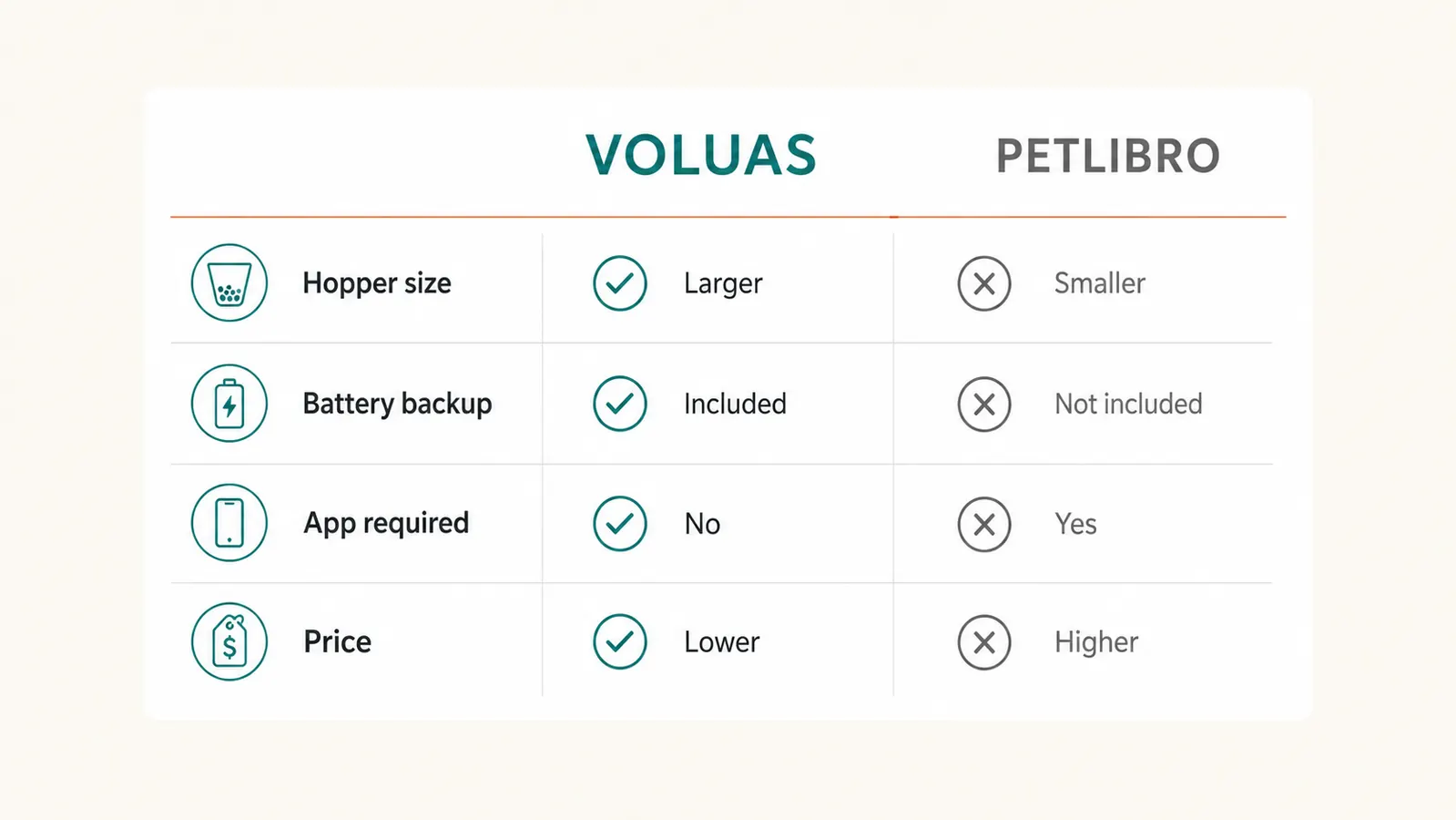
The biggest practical advantage the VOLUAS has is that it does not need your phone to work. You program it directly on the unit using physical buttons and a small LCD screen. That sounds minor until your router goes down, your Wi-Fi password changes after a firmware update, or you hand the feeder to a housesitter who does not have your app credentials. App-dependent feeders have a hidden dependency that most buyers do not think about until they are standing in a hotel lobby wondering whether the meal actually dispensed an hour ago.
The battery backup is the other thing that moves the needle for me. The VOLUAS runs on a standard AC adapter but keeps three AA batteries in reserve. If the power flickers during a storm, the unit holds its schedule and your cat still eats at 7 a.m. Most PETLIBRO models at this price point skip the battery backup entirely. That is a meaningful gap if you live somewhere with inconsistent power, if you travel frequently, or if you have a pet whose anxiety spikes the moment their routine breaks. A feeder that goes dark during a power blip is just an expensive bowl.
The 4L hopper is larger than the entry-level PETLIBRO options, which typically top out at 3L. For a single cat on a quarter-cup twice-daily schedule, that is nearly a two-week supply without a refill. For a small dog or a two-cat household sharing the feeder, it cuts your refill frequency noticeably. The 10-second voice recorder is a real feature, not just a gimmick. Biscuit responds to my voice more reliably than she responds to a mechanical click, and recording takes about 30 seconds of actual setup time. It works.
If you want reliable scheduled feeding without app dependency or power anxiety, this is the one to buy.
The VOLUAS has over 12,000 reviews and holds a 4.4-star rating. Battery backup, custom voice recorder, 4L hopper, zero Wi-Fi required. Check today's price before it changes.
Amazon Check Today's Price on Amazon →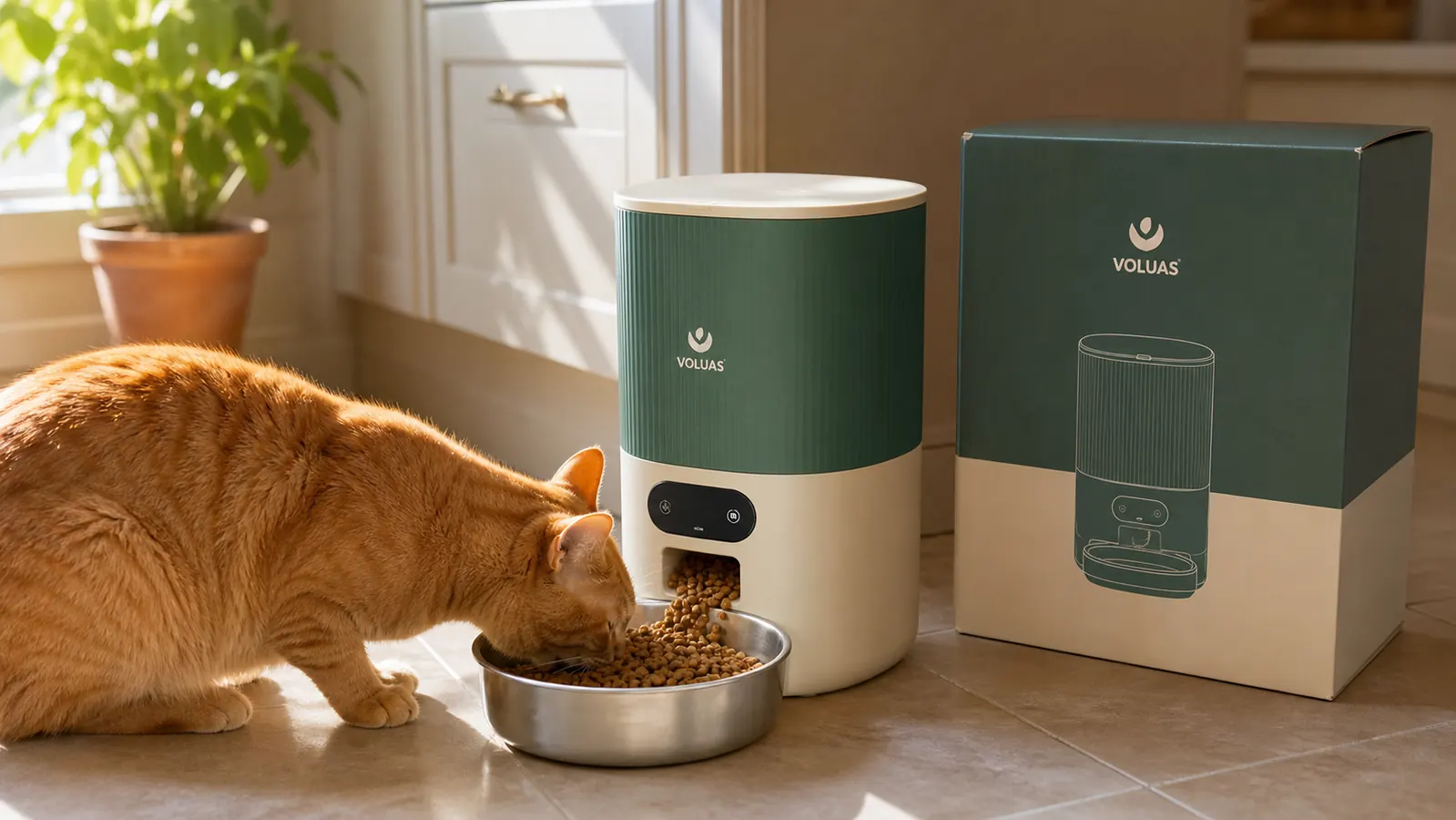
Where PETLIBRO Wins
The PETLIBRO has a real advantage on cleaning, at least on certain models. Several versions use a bowl that is rated dishwasher-safe on the top rack, which is a genuine convenience if you run the dishwasher daily and want a completely hands-off maintenance routine. The VOLUAS bowl is easy to rinse under the tap, but it is a hand-wash situation. For some people that is a non-issue. For others it will matter on week eight when you are tired.
If you specifically want remote control through a smartphone, including the ability to trigger a manual meal from your phone while you are stuck at work, the PETLIBRO models with Wi-Fi connectivity do handle that. It is a real feature. It just comes with the reliability tradeoff I mentioned above. If your home router is solid and you never lose power, the app experience is fine. PETLIBRO also has a wider model range than VOLUAS. If you want a feeder with a built-in camera, a stainless steel hopper, or a dual-port design for two pets feeding simultaneously from one unit, they have SKUs in that space. VOLUAS does not.
An app-controlled feeder sounds convenient right up until the moment your Wi-Fi goes down and your cat is staring at an empty bowl. Physical buttons and a battery backup solve a problem most buyers do not realize they have until it is too late.
Reliability Over Time: What the Review Data Suggests
With 12,251 reviews and a 4.4-star average, the VOLUAS has a large enough review pool to surface real failure modes honestly. The recurring complaints center on the rotor mechanism getting stuck on irregular kibble shapes, specifically very small pellets or oversized pieces that are not standard quarter-inch dry kibble. If your cat or dog eats a round or irregular-shaped kibble, test the dispense function before you commit to a full schedule. The hopper gasket also shows wear in reviews after a year or more of daily use. Neither issue is unusual for this category and both are documented openly in the reviews rather than buried.
PETLIBRO reviews generally skew positive on build quality, but app connectivity complaints are a consistent thread across multiple models and product generations. Reconnection issues after power outages, scheduling glitches that require a complete reset, and occasional phantom dispenses at the wrong time show up regularly in low-star reviews. That is not a dealbreaker on its own, but it is worth understanding before you commit to an app-dependent device for something as time-sensitive as your pet's meals. A feeder that dispenses an extra meal at 2 a.m. or skips a scheduled one while you are traveling creates real problems.
Setup and Daily Use
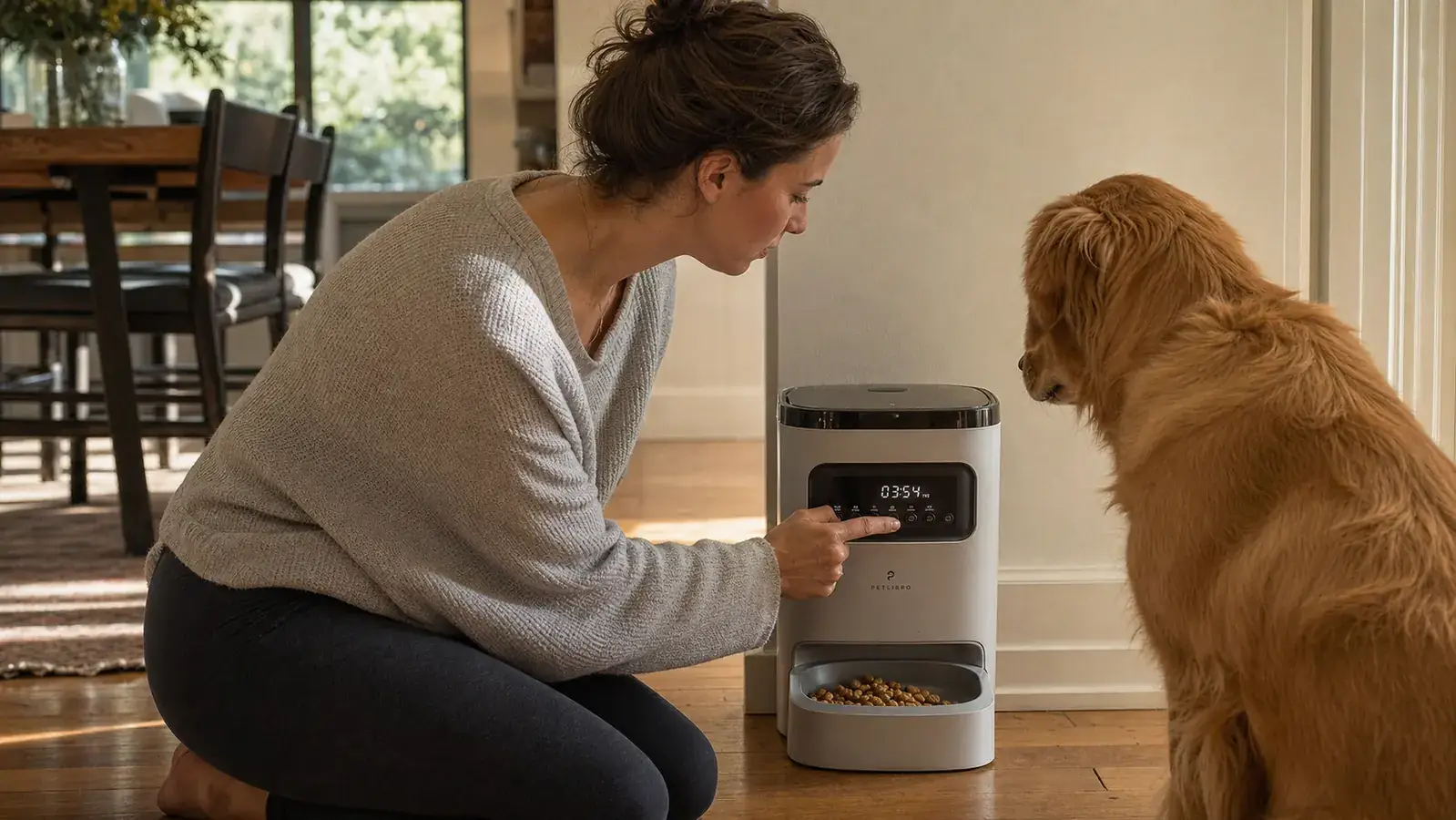
The VOLUAS setup takes about ten minutes the first time through. Load the hopper, connect the AC adapter, set the current time on the LCD, then program each meal time and portion size using the plus and minus buttons. Record your voice message and you are done. There is no account to create, no app to pair, and no QR code to scan and troubleshoot. If you need a refresher later, the physical button layout is logical enough that you will not need the manual after the first week of use. For a full step-by-step walkthrough, including how to handle kibble size adjustments and what the portion numbers actually translate to in volume, see the guide on how to set up an automatic pet feeder for cats and dogs.
I keep Biscuit and Pickles on a twice-daily schedule, 7 a.m. and 5:30 p.m., a quarter cup each per meal. The VOLUAS has not missed a scheduled meal in several months of continuous operation. I tested the battery backup by unplugging the unit intentionally during a scheduled meal window and the batteries held the schedule without any issue. That is exactly what you want from a feeder meant to handle the days you are stuck late, away for a weekend, or relying on a housesitter who does not want to think about your cat's hunger schedule.
Who Should Buy Which
Buy the VOLUAS if you want a feeder that works completely without a smartphone, handles a power outage without dropping its meal schedule, and does not require you to troubleshoot Wi-Fi connectivity at 6 a.m. on a workday. It is the right call for single-cat and single-dog households, multi-pet setups where two smaller animals share the unit, and anyone who travels and needs a housesitter to manage the feeder with zero tech involvement. At a budget-friendly price, it is also the lower-risk first automatic feeder if you are not sure yet how your pet will adapt to eating from a machine.
Buy the PETLIBRO if you genuinely want app-based remote control and have stable home Wi-Fi you trust completely, if a dishwasher-safe bowl matters more to you than battery backup, or if you want a camera-integrated model. It is also the right pick if you need a dual-outlet feeder for two pets eating at different portions simultaneously, since VOLUAS does not make that configuration. For the core use case, though, reliable scheduled feeding with minimal daily involvement, the VOLUAS solves it at a lower price with fewer points of failure.
If you want more depth on what the VOLUAS actually delivers over months of daily use, the long-term VOLUAS automatic feeder review covers six months of real feeding data, including how Biscuit stopped waking me up at 5:45 a.m. and what happened the one time the portion dial drifted.
Ready to stop guessing and start feeding your pet on a schedule that actually holds?
The VOLUAS handles up to 6 meals a day, holds 4 liters of dry food, and keeps running through a power outage. Over 12,000 pet owners have reviewed it. Check today's price on Amazon before it changes.
Amazon Check Today's Price on Amazon →